The Dog & the Sailor: Guided Tour

The Dog and the Sailor: A Queer Fairytale
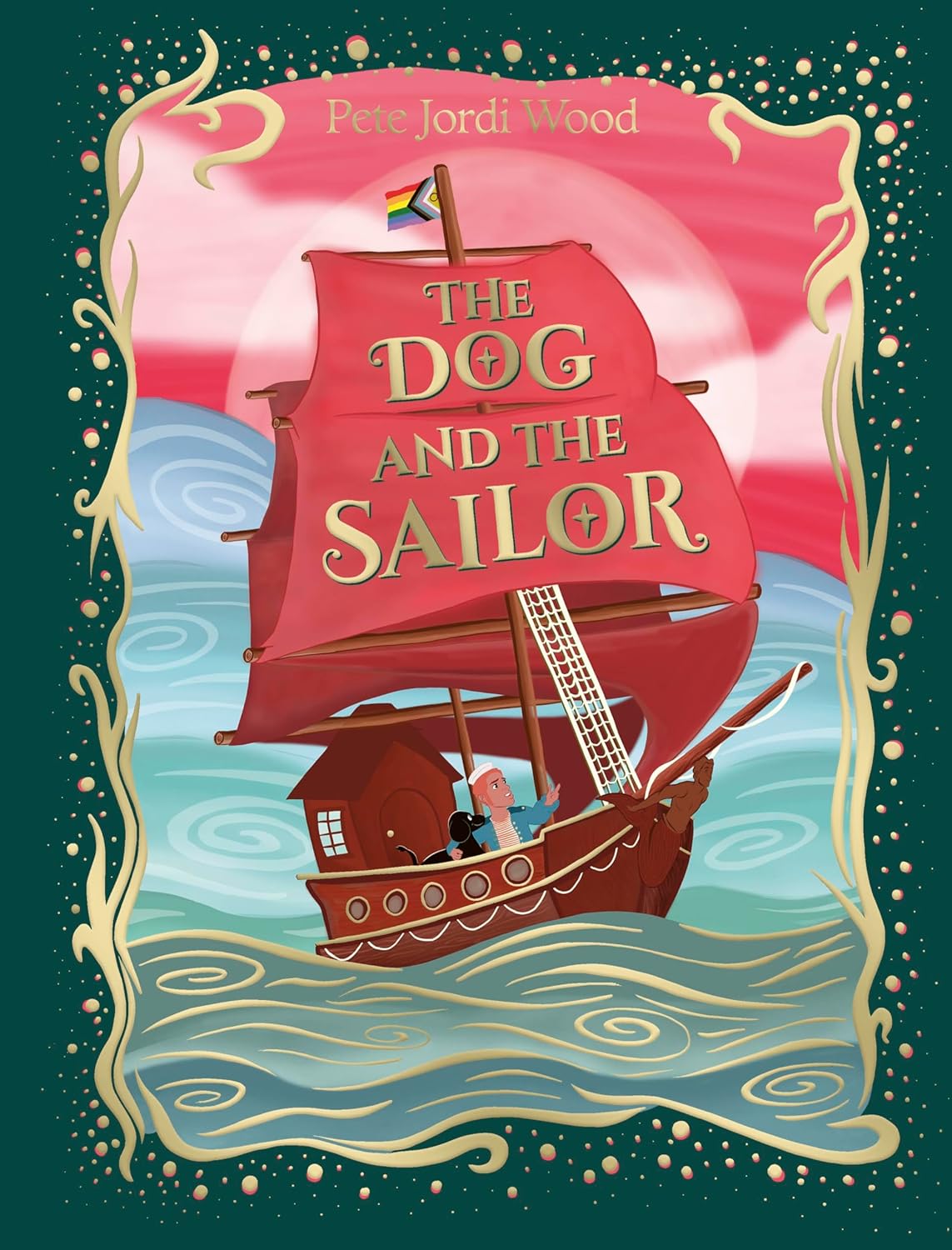
“The Dog and the Sailor” (2020) was a virtual online exhibition, written and illustrated by P. J. Wood, exploring a centuries-old, magical fairy tale recorded by several European folklorists in the Nineteenth Century. It features the story of a sailor who is the only man able to resist the beauty and seductive powers of a witch in order to defeat her and save the kingdom of a handsome prince.
The Dog and the Sailor: The Historical Sources
In this Danish folk tale we meet a young man who cares for his ageing, impoverished parents. The man longs to go to sea to become a sailor and be free of his duties, but his parents wish for him to stay with them. He defies his parents’ will to provide for his family, and runs away to sea... only for his new life to be turned upside down when his ship is destroyed, and he is washed up on foreign shores.
Here he meets a talking dog who aids him in his darkest hour, as he considers ending it all. Together they set off on a quest to defeat a tyrannical witch who has enslaved and enchanted a kingdom. As the tale reaches its finale, it is revealed that the sailor is the only male the dog could find who can resist being enchanted by the beauty of the witch and her powers to seduce any man who sets eyes on her. When the sailor defeats her, his travelling companion the dog is turned into a handsome prince, and he is offered “half the kingdom” in return for his heroism, and a permanent home in a fairy tale castle - essentially to rule with the prince side by side in what is an extremely rare union for a fairy tale. Having found everything he ever wanted - love, riches, adventure and recognition - the sailor chooses to make the ultimate sacrifice and return to his homeland to care for his ageing parents.
Sources:
This fairy tale is listed in the Aarne-Thompson-Uther (ATU) Tale Type Index as Tale Type number 540,“The Dog and the Sailor” (previously"The Dog in the Sea" in Stith Thompson’s AT Index). Multiple sources exist for the tale: the plot of Wood’s adaptation is most faithful to the tale collected by Jens Kamp in the 1800’s.
KAMP, Jens. 1879 [reprint 2019]. “David Husmandssøn” in Danske Folkeæventyr. India: Pranava Books.
UTHER, Hans-Jörg. 2011. The Types of International Folktales: A Classification and Bibliography, vol. 1-3. Helsinki: Academia Scientiarum Fennica and Folklore Fellows’ Communications.
The Dog and the Sailor: Three Adaptations
During a Masters degree in illustration at Falmouth University in Cornwall, P. J. Wood began researching traditional folklore in the hope of finding a fairy tale hero he could relate to as a member of the LGBTQ+ community. In 2019 he self-published his findings within his MA dissertation, bound in a little illustrated book of essays entitled "Queeries: Essays on Queer Theory and Fairy Tales". The book was selected as a finalist for the Katharine Brigg's Award, the British Folklore Society’s annual award for folklore research. The essay collection detailed his sources and his research into variants of "The Dog and the Sailor" tale-type across Europe. In his essay “Where is my Prince Charming? On Queer Visibility in Fairy Tales" he critically analyses how "The Dog and the Sailor" could possibly be viewed through an LGBTQ+ lens, rich in queer symbolism and subtext, such as the sailor being immune to the witch’s beauty and powers of seduction. He argued that the fairy tale includes a positive, nuanced portrayal of a protagonist who could be read as gay, bisexual, asexual, aromantic or otherwise queer.
Queeries included the first original adaptation of the folktale in the English language, in which Wood remained extremely faithful to its Danish sources. This first adaptation was based on a fusion of the plots of Jens Kamp and Nikolai Christensen’s variants, which Wood selected to adapt after learning he had Danish ancestry.
In this first adaptation, Wood’s sailor returns home at the end of the tale and sacrifices a life with the prince to care for his ageing parents. Wood has explained that for him the tale is not only a queer fairy tale, but a complex narrative about responsibility to one’s family. He has discussed how he was drawn to the tale not only for its apparent queerness, but for its portrayal of a man torn between duty to caring for ageing parents and personal freedom - a theme that resonated with him as a former child carer. As someone with a disability, he was also moved by the tale’s sensitive depiction of mental health and a man considering ending his life.
When the Covid 19 pandemic of 2020 derailed his final degree showcase, Wood decided to do his exhibition online. He created his own illustrated adaptation of "The Dog and the Sailor". He joined forces with his cousin, sound designer Joe Dines, and actor Dino Fetscher to create an audiovisual experience during the lockdown for his LGBTQ+ friends. Wood curated a virtual gallery featuring his fairy tale adaptation with his artwork, narrated by Fetscher, with an original score by Dines. The project was initially intended as a university assignment that no one would likely see, other than his classmates, friends on social media, and MA examiners. Drawn in a Disney style, the exhibition was geared towards adults in the queer community who never had an LGBTQ+ hero in fairy tales growing up. For this second adaptation, Wood decided to embrace the transformative nature of fairy tales across oral-storytelling traditions, Disney movie adaptations, evolving cultures and centuries, and altered - or ‘Disneyfied’ - the ending, allowing for the Sailor to find his happily-ever-after with the prince, as well as providing for the family he left behind.
When the exhibition launched, the story of Wood’s rediscovery of the tale attracted interest. The exhibition was featured in a viral Forbes article by journalist Jamie Wareham. Other LGBTQ+ press, in the UK and overseas, echoed support. Sir. Ian McKellan and Russell T. Davies shared the discovery of the tale with their followers. In its first week online, the exhibition received over 10,000 visitors. An accompanying hardback publication created for the exhibition, featuring Wood’s new adaptation in prose alongside the exhibition illustrations, limited to 1000 copies, soon sold out.
Wood went on to receive a two-book deal from Penguin Random House. A third, extended adaptation of the story was included in Wood’s anthology “Tales From Beyond the Rainbow" (Puffin Classics, 2023): an anthology of fairy tales based on historical sources which feature positive portrayals of protagonists who can be read as queer. Wood was then commissioned to illustrate a picture book version of this adaptation of “The Dog & the Sailor", published by Puffin Books in the United Kingdom in 2024.
Wood continued his research into queer folklore, receiving a studentship to pursue a Ph.D at the University of the Arts London, based at Falmouth University, where his research focuses on magical fairy tales and cartomancy. He is preparing to publish the results of his research as a new creative project.